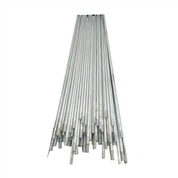

Medium-heavy Capacity Percussion Antaeus Earth Anchor
$45.00 | 300 piece(Min.Order)
Attention: Please confirm the price when you place order
Chisel shaped drive tip for quicker and straighter installs.
Hex drive technology allowing for stronger and easier to install anchors.
- Send Inquiry

- Add To Cart
- Product Introduction
KEY FEATURES
Enhanced Drive Efficiency: Chisel-shaped drive tip facilitates quicker and straighter installation.
Superior Strength and Installation: Hex drive technology enables stronger anchors and simplifies the installation process.
Increased Load Capacity: Larger surface area allows for higher potential load-bearing capabilities.
Faster Load Locking: Shorter rotation distances result in quicker load locking times and reduced overall drive time.
Reduced Component Count: Fewer drive rods are required, streamlining the installation process.
Adherence to CM Standards: All products are designed and manufactured to meet stringent CM specifications.
KEY BENEFITS
Rapid Deployment: Quick and easy installation using readily available equipment.
Immediate Availability: Anchors are ready for immediate use upon installation.
Enhanced Safety: Rigorous proof testing of each anchor ensures safety and reliability.
Minimal Site Disruption: No excavation or concrete work required, minimizing site disturbance.
Eco-Friendly: Environmentally friendly solution with minimal impact on the surrounding area.
Expert Support: Access to high-quality technical support from experienced professionals.
|
HOW CM EARTH ANCHORS WORK
1) Drive the CM Earth Anchor. Using readily available conventional tools and equipment, drive the CM Earth Anchor into the ground with a reusable CM Smasher Rod. 2) Remove the Smasher Rod. Once the CM Earth Anchor is driven to the required depth remove the CM Smasher Rod. 3) Proof Test. Anchor Lock the CM Earth Anchor while simultaneously proof testing to the required capacity. |
|
The Anatomy of a CM Earth Anchor
CM earth anchors are the result of years of constant testing and analysis of in situ site conditions and present to the market a product designed for the engineer and the installer.
CM earth anchors incorporate a number of significant features which improve its overall performance:
Hex Drive Technology
The unique shape of the CM earth anchor body allows it to have a slimmer, stronger profile, we call this Hex Drive Technology. This reduces the amount of effort required to drive the anchor into the ground while simultaneously increasing the overall strength. It also provides a wider scoop on the trailing end of the anchor, encouraging it to rotate and lock into position sooner and more reliably during proof testing. Hex drive also allows for clean angles, allowing the product to galvanise well thereby enhancing corrosion resistance.
CM Deflector
The CM Deflector protects the anchor tendon from damage while the anchor is being driven into the ground.
Load Max Technology
The reaction surface of CM earth anchors is optimised using clever load max technology. Years of experimentation have shown us that surface bearing angles of an anchor have an influence on bearing capacity. Therefore when we coupled the Hex shape of CM with the perfect angled wing, frustum cone angles were increased allowing it our CMs to carry higher loads. We call this LOAD MAX technology. This wing varies in size across the different CM models to cater for varying ground conditions.
CM Earth Anchor F.A.Q
What is an Earth Anchor?
A CM Earth Anchor is a geotechnical anchor designed for holding tensile loads. CM Earth Anchors can also be referred to as ground anchors, mechanical anchors, or more specifically, percussion anchors, driven anchors, or tipping plate anchors.
Will weather conditions affect the integrity of the anchors over time?
Only if the anchors are placed in soil which is affected by the weather. A responsible anchor design attempts to place anchors to a depth where the soil is unaffected by weather and seasonal variations. Or if soil variation is unavoidable, then the anchor must be sized and proof tested for the worst case soil condition.
Does the depth of the anchor affect the long term holding capacity?
Not unless the anchor depth is one that places the anchors into soil that is unstable or seasonally variable. In general, greater depth usually results in greater capacity, but not always. In some cases loose wet soil can exist below stable competent soil, so increased depth can be a detriment. Anchors should be placed into soil that will not be subject to freeze thaw cycles.
How far apart do the anchors need to be from each other?
A conservative rule of thumb is to place the anchors no closer than the depth to which they are installed, but in many retaining wall installations anchors are placed as close as 1.5m x 1.5m rectangular pattern. Account for a 25% load loss factor which represents a reasonable maximum interference factor as the anchors cannot practically be placed any closer together. If interference of anchors is a concern then this is a reasonable way to account for this effect.
What is the best way to link multiple anchors together to one guy line or other structure?
A steel spreader structure with multiple anchor attachment points and one guy line attachment point. The CM anchor rods (CTB or All thread) pass through the steel spreader structure and are terminated with steel plates, beveled washers, and hex nuts.
What is the Proof test based upon?
The working load, the application, and a responsibly chosen safety factor, limited by the structural capacity of the anchor assembly. For example: Working load = 44kN, Safety factor = 2.00, Proof Test = 89kN with less than 1.27cm movement over 1 minute should provide a very safe anchor for 45kN working load.
Should the pilot hole be drilled for the entire depth of the anchor, or should the anchors be driven for the last 0.5m?
We have seen installations with both methods, depending upon the soil. In some very hard, slippery soils it was most effective to drive the anchors a bit beyond the end of the pilot hole if possible. But sometimes it is not possible, and in these cases it is best to do a good job of back filling and compacting prior to load locking. We have seen some retaining wall installations where the Specifying Engineer did not allow the pilot holes to be drilled beyond the failure plane, and required the pilot holes to be filled with grout after installation.
What should we do if the anchor does not tip and lock in place and slides back up the hole?
This does happen occasionally in some hard slippery soils where a pilot hole has been drilled. We have not had a report of this happening where the anchors were driven without a pilot hole. If a pilot hole is used it is wise to back fill the hole with the drill cuttings after the anchor is placed, but before load locking. It is wise to back fill and compact the soil (usually done with the drive steel) prior to load locking because it will help the anchor to tip and lock. We have seen some installations where the drive steel was placed backwards down the hole to hit the scoop of the anchor to start it to tip and lock. We have had some installers sharpen the scoop with a grinder to help it grab into hard soil. It is generally accepted by most installers that the anchors lock better if the initial pull is done at as fast a speed as possible.
Can anchors be installed in Permafrost or frozen soil?
Yes, CM anchors work very well in frozen soil, but a pilot hole is usually a requirement. If there is only 1m or less of frozen soil, then the anchor can be driven through the frozen soil into the underlying non frozen soil. If the soil is frozen for the entire installation depth then a pilot hole will be required. Beware, frozen soil is very tough and may require heavy duty mechanized drilling and driving equipment. Anchor capacities in frozen soil are very high as long as the soil remains frozen, but if the soil around the anchor thaws the soil will revert to its thawed, lower capacity state. If the soil is of good high capacity prior to freezing, then this is not as large a concern.
Why does the Proof Tester register 18kn when there is obviously no load on the anchor and the valve handle is in the neutral position?
This is a characteristic of the hydraulic valve on the load locker called trapped pressure. Hydraulic pressure is trapped on both sides of the cylinder piston and registers on the gage. When the valve handle is pulled to retract the piston, the gage reads zero. This does not affect load locking of the anchors if the proper procedure is used. Refer to the Operation Manual for more details, and the proper load locking procedure.
What if I want to hold a constant load for a period of time as a proof test?
This is our recommended proof test method. We suggest that you set the bypass valve on the load locker to that load. This allows the installer to shift the valve on the proof tester wide open while the bypass valve limits the pull force to the bypass setting. Then the installer can monitor movement of the anchor without worrying about the load level. Instructions for setting the bypass valve are included with each load locker.
What is the origin of the Ultimate Holding Capacity Charts?
The published holding capacity charts have been developed over the years from a combination of sources. The primary source has been projects with geotechnical soil data and proof test results. Secondary sources are analytical prediction methods and mathematical interpolation and extrapolation based upon the analytical parameters of anchor bearing area, depth, angle of internal friction, and blow count.
What is The Blow Count (N) of the soil?
The blow count is a byproduct of geotechnical soil sampling, and is an indicator of the hardness and capacity of the soil. The higher the blow count the harder and more competent the soil is. Higher blow counts mean it will be harder to drive the anchors into the soil, but capacities will be high. Lower blow counts mean it will be easier to drive the anchors into the soil, but capacities will be lower. CM anchors work well in soils with blow counts from about 7 to 50. The best performance is obtained in soils with blow counts from about 15 to 30.
What is the design life expectancy of a CM anchor?
CM anchors with galvanized cables should be considered only for temporary applications. The weak link of the CM anchor is the stranded wire rope tendon. In Moderate soils they should be limited to two years or less of service. The next step up in corrosion resistance is to replace the galvanized steel cable with Grade 316 Stainless cable with copper ferrules. This provides the greatest corrosion resistance available for cabled CM anchors, but still should be limited to approximately 10 years of service. If more than 10 years of service is desired, then the clevis type CM anchor which accommodates a rod, should be used. CM with hot dip galvanized steel bar tendons above 20mm can be considered for up to 50 years life span and 75 years when coated with CM hard armor.
What about corrosion of the internal threads on the CM anchor shackles and anchor rod coupling nuts?
The internal threads are actually protected by the galvanizing from the rod that is threaded into them. This was graphically proven on a utility guy anchor that was retrieved from an extremely corrosive environment complete with stray currents(杂散电流) and aggressive soils. The anchor rod and shackle of the anchor were corroded to approximately 50 % of their original dimensions (the residual strength would have been about 25 percent of original). Disassembly of the shackle and the rod showed that the internal threads of the shackle and the external threads of the anchor rod had retained their original dimensions.
What about grout for corrosion protection?
Grout is commonly used with CM anchors to enhance holding capacity and to provide corrosion resistance at the expense of a more complicated installation. Typically a grout tube is attached to the anchor rod and grout is pumped through the grout tube to the bottom of the hole. This has historically provided good coverage of the anchor, shackle, and anchor rod, but there are many variables and care must be taken to ensure good complete coverage.
| Email: | lindaguo@earth-anchoring.com |
| Mobile: | 0086-13935114760 |
 |
Hot Tags: Medium-heavy Capacity Percussion Antaeus Earth Anchor, China, suppliers, manufacturers, factory, customized, quotation, low price, in stock, free sample, made in China, Heavy Capacity Percussion Earth Anchor, Cm Style Medium heavy Capacity Percussion Earth Anchor, Sting Ray Style Heavy Capacity Percussion Earth Anchor, Chisel Style Medium heavy Capacity Percussion Antaeus Earth Anchor, Manta Ray Style Medium heavy Capacity Percussion Antaeus Earth Anchor
You Might Also Like