




Percussion Earth Anchors for Solar Farms: Foundation Performance in Variable Soils
 Nov 02, 2026|
Percussion Earth Anchors for Solar Farms: Foundation Performance in Variable Soils
Utility-scale solar power plants require foundation systems capable of enduring continuous uplift and lateral wind loads over a 25- to 30-year operational life. While traditional concrete piers or driven steel H-piles are common choices, challenging ground conditions-such as shallow bedrock, high water tables, and expansive clays-frequently lead to installation delays and budget overruns.
Percussion earth anchors (tipping-plate anchors) have become an increasingly popular alternative for utility-scale solar tracker systems and fixed-tilt mounting structures. By utilizing native soil mass for tension resistance, these mechanical anchors deliver high uplift capacity with minimal land disturbance and zero concrete cure time.
1. Navigating Geotechnical Hazards on Solar Job Sites
Solar project sites are often selected on marginal, non-arable land featuring complex subsurface geology. Percussion earth anchors solve three primary geotechnical issues commonly found on large-scale solar farms:
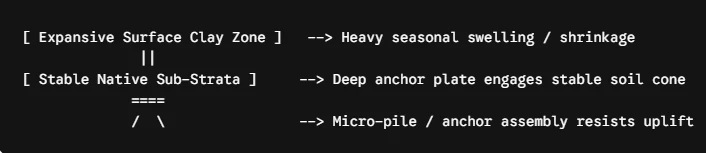
Expansive Clays and Frost Heave: Surface soils expand and contract with seasonal moisture changes and freeze-thaw cycles, creating heavy vertical jacking forces on rigid shallow piles. Percussion anchors are driven past the active frost and moisture zone into stable sub-strata, anchoring deep below the heave threshold.
Shallow Bedrock and Boulder Obstructions: Driven steel piles can deform or fail to hit required embedment depth when encountering dense rock layers or subterranean boulders. Slender percussion earth anchor strings easily maneuver through fractured rock and dense till matrices, achieving required holding capacity where heavy piles refuse.
Corrosive and Waterlogged Terrain: Solar farms situated in low-lying or wetland areas present high soil resistivity hazards. Heavy-duty hot-dip galvanizing (ASTM A153 / ISO 1461) protects anchor assemblies from localized pitting corrosion in anaerobic, saturated soils.
2. Speed and Scalability: Lowering Total Balance of Plant (BOP) Costs
For engineering, procurement, and construction (EPC) contractors managing thousands of anchor locations per site, installation efficiency directly dictates project margins:
Rapid Installation: Using light hydraulic breakers attached to compact track loaders or mini-excavators, field crews can install and load-lock a percussion earth anchor in under 5 to 10 minutes.
Immediate Proof Testing: Unlike concrete footings that require up to 28 days to cure, percussion anchors are proof-loaded immediately during the load-locking phase. Every anchor installed on a solar farm receives instant, verifiable tension rating confirmation on-site.
Civil Impact Reduction: Installing percussion anchors requires no bulk excavation, soil removal, or heavy site grading. This preserves existing vegetation and topsoil drainage patterns, simplifying environmental permitting and post-construction site remediation.
3. Foundation Performance Comparison for Utility Solar
| Metric / Parameter | Percussion Earth Anchors | Driven H-Piles / C-Channels | Poured Concrete Piers |
| Uplift Performance in Loose Soil | High (Engages deep soil cone) | Moderate (Relies on skin friction) | High (Relies on dead weight) |
| Tolerance for Frost / Clay Heave | High (Anchors below active layer) | Low to Moderate (Prone to jacking) | Moderate |
| Cure & Testing Delay | Zero (Immediate load capacity) | Zero | Delayed (7--28 days) |
| Equipment Footprint | Compact (Mini-excavators/skid steers) | Heavy (Large pile drivers) | High (Concrete trucks/drilling rigs) |
| Decommissioning / Reclamation | Fast & low impact | Moderate effort | High cost & soil disturbance |
Q: Why are percussion earth anchors effective against frost heave on solar sites?A: Percussion anchors are driven past the shallow active frost layer into stable, unfrozen soil sub-strata. The load-locked tipping plate engages native soil beneath the frost zone, neutralizing upward surface jacking forces.
Q: How do percussion earth anchors lower Balance of Plant (BOP) costs for solar EPCs?A: They eliminate concrete trucks, excavation equipment, and curing wait times. Small crews can drive, load-lock, and instantly verify hundreds of anchor points daily using compact site machinery.
Q: Can percussion anchors handle high lateral wind loads on single-axis solar trackers?A: Yes. When paired with articulated ground plates or installed at inclination angles aligned with guy wires and torque tube frames, percussion anchors effectively convert lateral wind shear into direct axial pull along the anchor rod.