




The Engineering Behind Percussion Earth Anchors: How Tipping Plates Mobilize Subsurface Soil Resistance
 Oct 28, 2026|
The Engineering Behind Percussion Earth Anchors: How Tipping Plates Mobilize Subsurface Soil Resistance
When securing critical infrastructure-such as high-voltage transmission towers, utility guy wires, slope retention systems, and civil retaining walls-traditional concrete foundations are often costly, weather-dependent, and disruptive to the surrounding terrain.
Driven percussion earth anchors have emerged as the industry standard for geotechnical tension holding systems. By driving a specialized mechanical anchor head deep into undisturbed soil and activating its internal tipping mechanism, engineers achieve immediate, high-capacity tension load-holding without excavation, wet concrete curing, or massive site disturbance.
Understanding the practical mechanics of how tipping-plate anchors work underground helps civil contractors, utility project managers, and procurement leads select the right hardware for challenging site conditions.
1. The Three-Step Installation Cycle: Driven, Tipped, and Locked
Unlike traditional helicals or earth screws that cut through soil threads, percussion earth anchors rely on a streamlined mechanical process that minimizes soil disruption during installation:
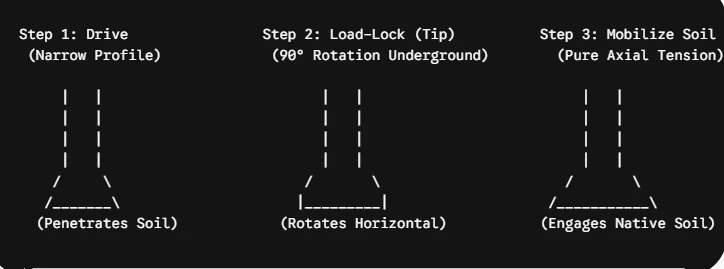
Precision Percussion Driving: The earth anchor head is fitted with a drive rod and hammered into the earth using standard hydraulic or pneumatic equipment. Because the anchor body enters the soil in a narrow, streamlined orientation, it encounters minimal penetration resistance, passing smoothly through dense clays, compacted gravels, and sandy matrices.
Underground Tipping (Load-Locking): Once target embedment depth is reached, the drive rod is extracted. Upward axial tension is applied to the anchor cable or rod. This upward pull catches the anchor's offset hinge mechanism, forcing the buried plate to pivot 90 degrees underground-transforming it from a slender driving wedge into a broad, flat bearing plate.
Immediate Soil Cone Mobilization: Once locked horizontally, the anchor plate directly compresses the undisturbed soil column above it. The anchor acts as an underground structural shield, anchoring into the native strength of the deep earth.
2. Key Hardware Features for Long-Term Field Performance
To guarantee a 50+ year operational service life in aggressive underground environments, each component of a percussion earth anchor assembly must satisfy strict manufacturing quality controls:
Drop-Forged Anchor Bodies for Ductile Strength: Cast iron anchor heads often harbor microscopic internal air pockets that can snap under heavy impact driving or sudden seismic loads. High-grade drop-forged alloy steel offers a continuous, solid grain structure that provides exceptional impact toughness and pull-out ductility.
Articulated Ball-and-Socket Joints: When guy wires or structural cables shift under dynamic wind vectors, rigid connection joints experience severe flexural strain. Utilizing drop-forged, multi-axis socket assemblies at the ground surface allows the connection to pivot naturally, converting lateral bending forces into pure axial tension along the buried rod.
ASTM A153 / ISO 1461 Hot-Dip Galvanizing: Subsurface moisture and soil chemistry cause rapid oxidation in bare steel. Heavy-duty hot-dip galvanizing applies a thick, metallurgically bonded zinc shield that protects against soil corrosion, acidic runoff, and microbial attack.
3. Practical Field Advantages for Infrastructure Projects
Zero Excavation & Zero Curing Time: Traditional poured-in-place concrete footings require excavation, spoil removal, and days of concrete setting time. Percussion anchors are mechanical and load-testable immediately after installation, saving significant project labor and schedule overhead.
Minimal Environmental & Thermal Impact: In environmentally sensitive areas-such as steep mountain slopes, wetlands, or arctic permafrost zones-driving slender mechanical anchors eliminates large excavation footprints and thermal hydration heat, preserving natural ground stability.
Instant Load Verification: Every percussion earth anchor is proof-loaded during the load-locking phase. Site inspectors receive immediate, real-time verification of load holding capacity right on the hydraulic pressure gauge before structural loading begins.
Q: What is the main operational difference between a percussion earth anchor and a helical ground screw?
A: Helical anchors are screwed into the ground using rotary torque, cutting a continuous spiral path through the soil. Percussion earth anchors are hammered straight down in a narrow profile and then pulled upward to rotate 90 degrees underground, locking against undisturbed soil without turning or shearing the surrounding earth.
Q: What happens during the "seating distance" phase of installation?
A: When tension is first applied to a driven anchor, it moves upward slightly (5 to 15 cm) as it rotates 90 degrees into its locked bearing position. This slight linear movement is called the seating distance and is factored into initial target driving depths.
Q: Why is drop-forged steel preferred over cast iron for heavy-duty earth anchor hardware?
A: Drop-forging refines the internal grain structure of the steel, eliminating internal porosity and air pockets. This makes the anchor head far more resistant to impact fracture during high-frequency driving and protects against sudden brittle failure under extreme tensile loads.